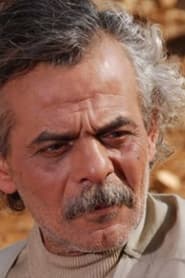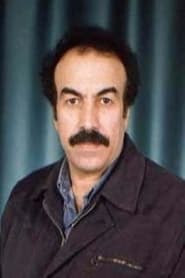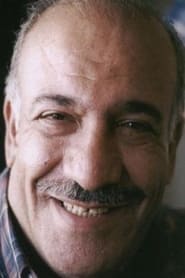
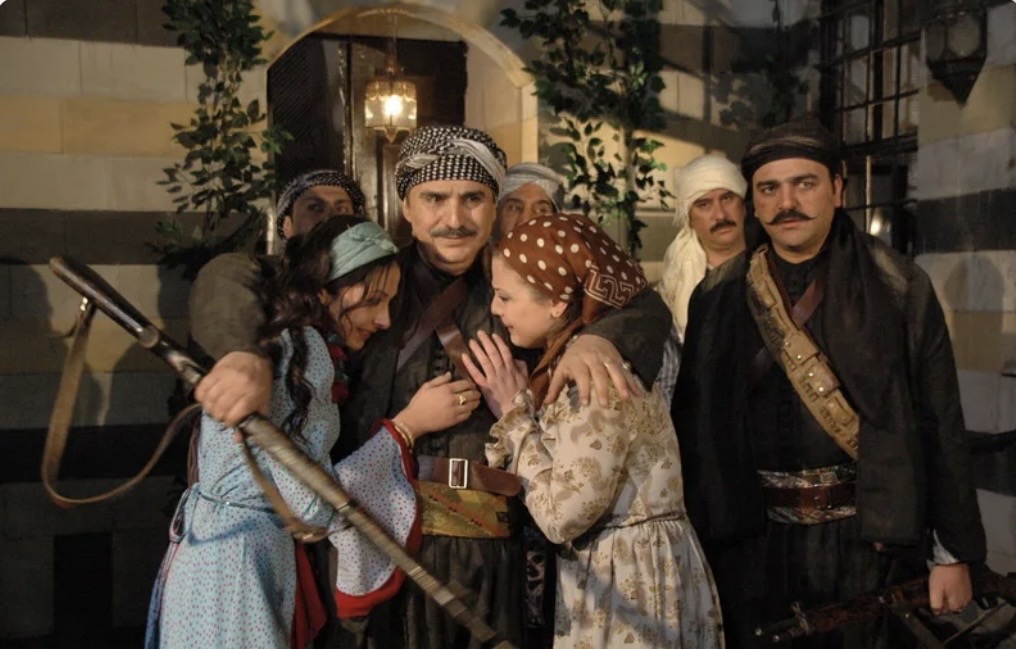
Bab Al-Hara isn't just a series you watch and finish — it's part of the memory of an entire Arab generation. The early seasons are worth watching, rewatching, and watching yet again; the later seasons are worth watching because they carry what remains of the alley we fell in love with.
And if you belong to the generation that didn't live through Bab Al-Hara on its first run — start from the first season, and you'll understand why millions of Arabs dropped everything every Ramadan night for years.
Available on the Shahid platform and the MBC Drama channel.
In Ramadan 2006, the gate of the alley swung open — not an ordinary gate, but the gate of a Damascene quarter that ushered millions of Arabs into a world they had never known in such depth before. Twenty years later, that gate is still open.
Bab Al-Hara didn't just teach Arabs the Levantine dialect — it taught them to long for a time they never lived, and for values that are all but vanishing.
What Made the Alley Live in Our Hearts?
The first secret was in the characters — Abu Issam, Umm Issam, Abu Shihab, Al-Nimes, Umm Waddah, and dozens of others, each carrying their own contradictions, their weaknesses and their strengths. None of them was a flawless hero or a purely evil villain — they were human, and that alone was enough to make you love them or hate them with real depth.
The second secret was in the setting — the first five seasons were filmed in a Damascene village in the Damascus countryside, and the show shone a light on Damascene life, on noble values, and on old customs and traditions. The attention to visual detail made the viewer feel they were looking out onto a real life, not merely a set.
And the third secret — the most important — was timing. The series arrived at a moment when Arab drama was searching for an identity, and it offered an authentic local model instead of imitating the West or adapting from the Turks.
From Harat Al-Dabaa to Harat Al-Salihiyya — A Twenty-Year Journey
What began as a single season turned into a phenomenon renewed every Ramadan. The first three seasons were the golden ones — Marwan Qawuq writing and Bassam Al-Malla directing, a duo that was never matched at the same level afterward.
| Seasons | Years | The arc |
|---|---|---|
| 1 – 3 | 2006 – 2008 | The golden seasons — a peak never surpassed |
| 4 – 6 | 2009 – 2011 | A solid evolution as the cast began to widen |
| 7 – 10 | 2012 – 2016 | The era of change — new characters arrive, others depart |
| 11 – 13+ | 2019 – present | Continuity at the expense of the original essence |
More Than a Series — A Social Phenomenon
Bab Al-Hara did what series usually don't — it redrew the Arab cultural map. Egyptians learned the Levantine dialect, Gulf Arabs discovered the Damascene heritage, and Moroccans found themselves weeping over characters from a Damascus they had never visited.
Bab Al-Hara turned names like "Abu Issam," "Umm Waddah," and "Al-Nimes" into shared cultural references — say them at any Arab gathering and everyone understands you. This kind of collective presence isn't made by production alone; it's made by human sincerity.
What Made It Timeless
- Multidimensional, non-stereotypical human characters
- An authentic Damascene setting, rendered with precise and loving detail
- Dialogue that carries the spirit of its time and place together
- A rare, seamless blend of the personal and the national
- An unrivaled, unifying Arab cultural impact
What Weakened It Over Time
- The later seasons lost the warmth of the early ones
- The departure of the original characters cost the show its identity
- Dramatic repetition set in after the sixth season
- Stretching the running time at the expense of the stories' depth
- The difficulty of sustaining quality across so many seasons
AMDB rating for Bab Al-Hara: 9/10 for the first three seasons — a masterpiece of Arab drama never surpassed. For the series as a whole — a priceless legacy, even if its later steps stumbled.