
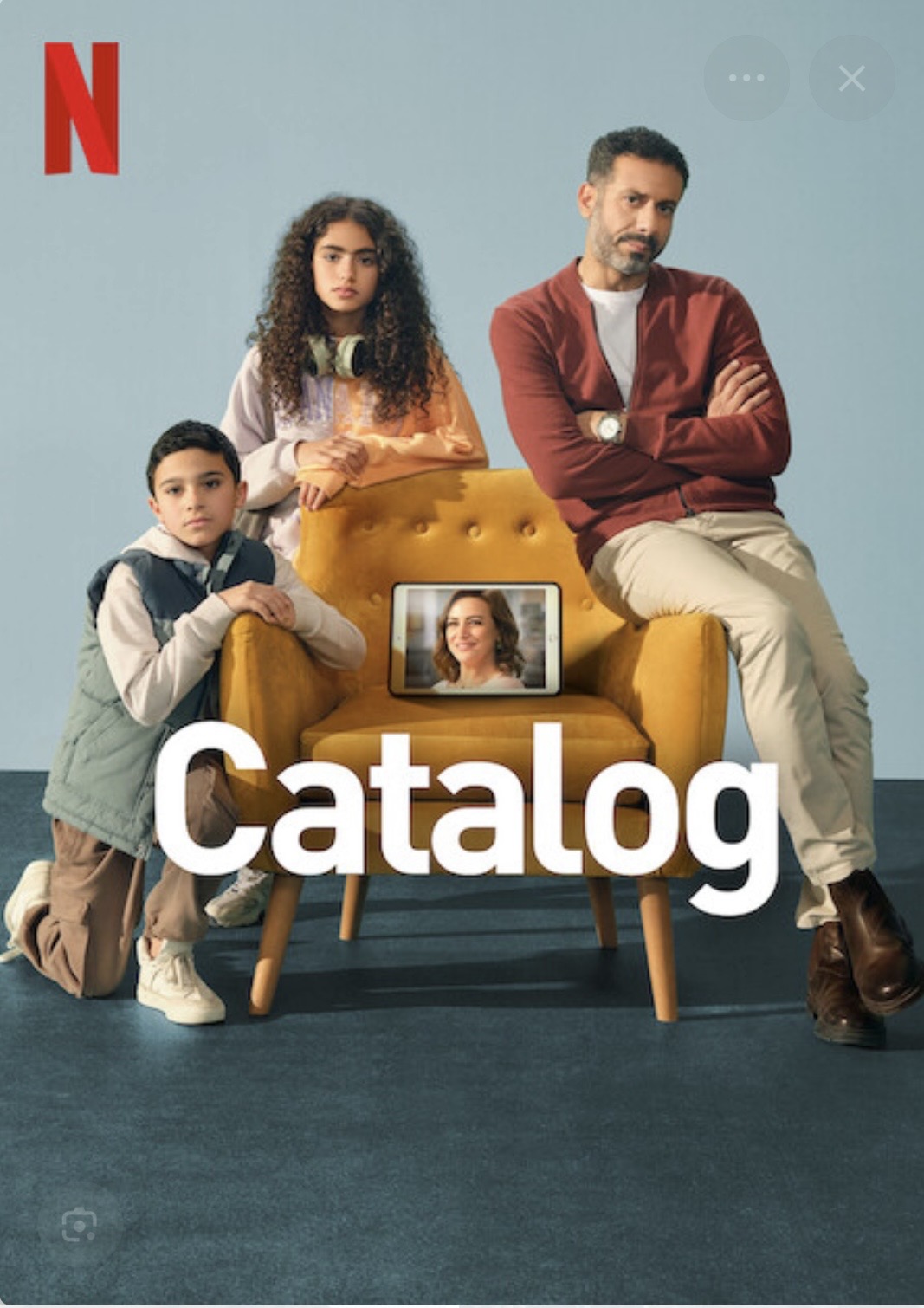
What if the people you love left you a guide to life after they were gone? This question — simple on the surface, profound at its core — is what the Katalog series builds its entire world upon, and what makes it reach the heart, not just the mind. This Katalog series review 2025 unpacks why Catalog became one of Netflix's most affecting Egyptian dramas of the year.
The Story: Youssef, Amina, and an Unplanned Catalog
Youssef loses his wife Amina suddenly, and finds himself alone facing the responsibility of raising their two children, Karima and Mansour. He is a father who never mastered this role — Amina was the family's backbone, the one who organized, raised and loved in a way whose value Youssef did not grasp until after she was gone.
In the midst of his grief he discovers Amina's YouTube channel under the name "Catalog" — a series of parenting videos she had been recording before her death, in which she explores the principles of modern positive parenting. Youssef treats these videos as a "catalog for life" that guides him in how to deal with his children, bringing about a major transformation in his relationship with them — and leading the family toward genuine understanding and love, within a human dramatic frame laced with comedy.
The idea, in its simplicity, carries a rare depth: a woman who was preparing for absence before absence announced itself — who wants to be present even while she is gone. That is the very essence of Catalog.
Mohamed Farag and Reham Abdelghafour — A Performance That Makes You Cry and Laugh at Once
A father learning anew — Mohamed Farag plays a broken man who does not know how to express his love, and who gradually transforms, through his late wife's videos, into a different kind of father. It is one of Farag's most mature and human roles to date.
A mother present despite her absence — Reham Abdelghafour plays a character who appears only in recorded videos, yet her presence fills the entire series. An exceptional performance that proves a small amount of screen time does not mean a small impact.
Writing and Direction: Ayman Wattar and Khaled El Halfawy — A Quiet That Pierces the Heart
Ayman Wattar, in his first attempt at long-form social drama, proves he is a writer who understands the human being before he understands drama. Catalog is written in an everyday language you feel was drawn from real life — no artificial dialogue, no contrived situations to stir emotion, just simple scenes that make you cry because they look like you.
Khaled El Halfawy directs Catalog with a measured visual calm that touches reality — the series is marked by its realistic storytelling and its educational values, and by direction that combines visual refinement with emotional messages. There is no noise in the image and no exaggeration in the lighting — everything serves the human condition.
The decision to release the series all at once on Netflix was a wise one — eight intense episodes that complete one another and make you feel you are watching one long film rather than a fragmented series.
AMDB's Verdict — 9/10
One of the most beautiful works Egyptian drama has offered in recent years — an original idea, an exceptional performance, and a story that will stay in your heart long after the final episode ends.