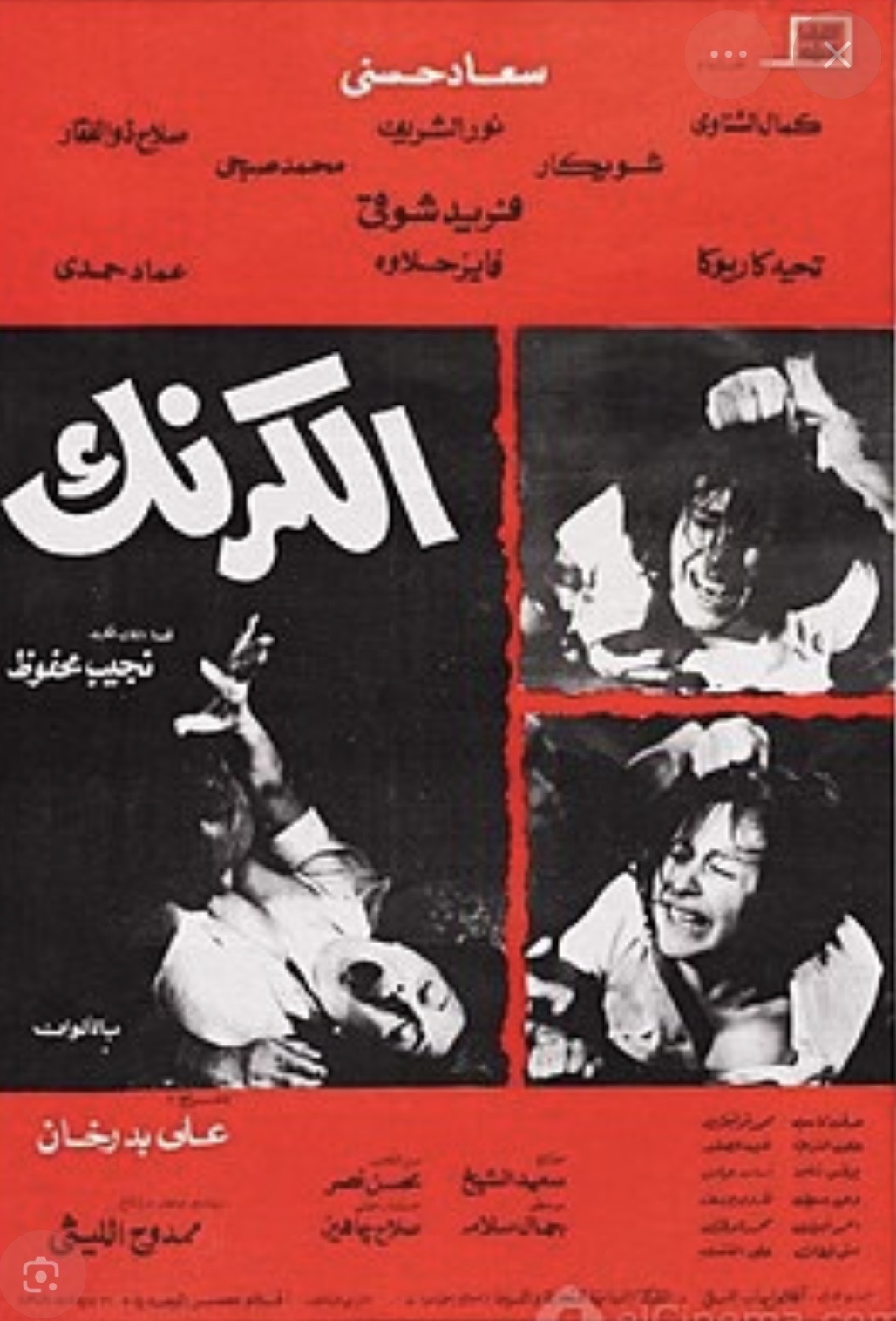
Fifty years have passed since Al-Karnak, and it still hurts. Not because it mastered the craft of pain, but because it mastered the craft of truth. And that is a rare skill in any cinema, in any era.
This Al-Karnak film review revisits a work that turned a short Naguib Mahfouz novel into one of the bravest political statements Egyptian cinema has ever made. Karnak, directed by Ali Badrakhan in 1975, remains a wound that refuses to close.
The Story: Karnak Café, Where Thinking Is a Crime
In a humble coffeehouse called "Al-Karnak," a group of young Egyptians gathers in the 1960s — university students who dream, talk, and argue. They carry no weapons and belong to no organization; it is enough that they meet and that they think. And that alone is enough for the security services to hunt them down, arrest them, and subject them to the cruelest methods of physical and psychological torture.
Zeinab, Ismail, and Hammada — three friends whose lives are shattered, not for any crime they committed, but because they happened to exist in the wrong time. The film tells their story from the moment of arrest until their release after that era ends, leaving behind wounds in every scene that are never bandaged.
Naguib Mahfouz did not write the Al-Karnak novel to tell a story — he wrote it to indict an entire era. And Ali Badrakhan carried that indictment to the screen with astonishing fidelity.
The Literary Source: When a Novel Becomes Testimony
Naguib Mahfouz wrote the novel Al-Karnak in 1974 — immediately after the October victory — at a historical moment when the political climate permitted a degree of boldness that had not been possible before. The novel is small in size but heavy in weight: a frank record of Mahfouz's objection to political repression under Abdel Nasser.
What makes this choice exceptional is that Mahfouz did not write from a safe distance. He wrote about a time that was still recent, about wounds that had not yet healed. Turning that novel into the film Al-Karnak in 1975 was, in itself, a bold political and cultural act.
The Direction: Ali Badrakhan and the Genius of Tension Without Excess
What stands to Ali Badrakhan's credit in Al-Karnak is the brilliant direction that managed to turn Mahfouz's literary text into a dense, powerful cinematic work, its rhythm charged with tension yet free of exaggeration or crudeness. This balance is the hardest thing in depicting violence and repression — how to show it without turning it into spectacle, and how to move the viewer without sliding into melodrama.
The scene of Zeinab's arrest and interrogation in front of her fiancé Ismail remains one of the harshest and most affecting scenes in the history of Egyptian cinema — not because it is filmed with exaggerated cruelty, but because it is filmed with an unbearable, painful honesty. Badrakhan understands that the most powerful moments of pain are the ones that do not scream.
The Performances: A Cast That Will Never Be Repeated
Al-Karnak brought to a single screen an elite roster of the greatest talents Egyptian cinema produced in the twentieth century.
A Central Role
Soad Hosny as Zeinab delivers one of her deepest roles — tenderness itself reshaped in the mold of shock, breakage, and endurance. Nour El-Sherif plays Ismail with a genuine human fragility that never pretends to heroism. And Kamal Al-Shenawy as the officer draws, with quiet ferocity, the figure of an interrogator who understands exactly what he is doing and chooses to do it anyway — which is far more disturbing than the conventional villain.
A Film That Was Almost Never Seen: The Ban and Sadat
Al-Karnak did not reach audiences easily. After shooting wrapped, the Minister of Culture at the time, Youssef El-Sebai, issued an order banning its release — which drove producer Mamdouh El-Leithy to meet President Anwar Sadat in person. Sadat watched the film and approved its screening.
But the approval came at a price. The filmmakers were asked to alter the final scene so that events would end with Sadat's May 15 decisions to release political prisoners, instead of the ending of Mahfouz's novel, which was tied to the 1967 defeat. This change makes the film, in part, a piece of political messaging for the Sadat era — something some critics see as a shadow over its achievement.
Yet the irony is that this film — banned, then permitted under conditions — became the most enduring and the most present in Egyptian cinematic memory. As if the truth cannot be banned forever.
A Document That Does Not Age
Al-Karnak sits among the hundred best films in Egyptian cinema of the twentieth century — and that ranking is no academic courtesy. It is a confirmation of a truth witnessed by anyone watching the film for the first time today: its impact has not eroded with the passage of time.
AMDB rating for Al-Karnak: 9.5/10 — the masterpiece of Egyptian cinema that does not age. The boldness of Naguib Mahfouz, the genius of Ali Badrakhan, and the performances of Soad Hosny and Nour El-Sherif in a single film that will never be repeated.
Why You Should Watch It Today
Because Al-Karnak teaches you that when cinema is completely honest, it becomes stronger than both censorship and time. Because Soad Hosny in this film alone is enough to understand why she was given the title "Cinderella of Egyptian Cinema." And because the questions the film raises about repression, freedom, and human dignity have not yet found their answers.
Fifty years have passed since Al-Karnak — and it is still watched, still taught, still preserved. And that alone is enough to tell you everything.